
Why AI Readiness Must Start Before the Workplace
Explore why preparing young innovators early with AI skills, data fluency, critical thinking, and ethical judgment is essential for Saudi Arabia’s future AI economy.
Artificial Intelligence is fundamentally changing the meaning of readiness. For years, digital readiness simply meant knowing how to use technology. Today, that is no longer enough. The next generation will not be measured by how quickly they can use AI tools or generate automated answers. Those are commodities.
The real value has shifted. The future belongs to those who can ask better questions, interpret the nuance of data, and make ethical decisions when technology moves faster than regulation. This is why preparing innovators must start early, long before they enter the workplace. It must begin while young people are still forming their mental models of how value is created.
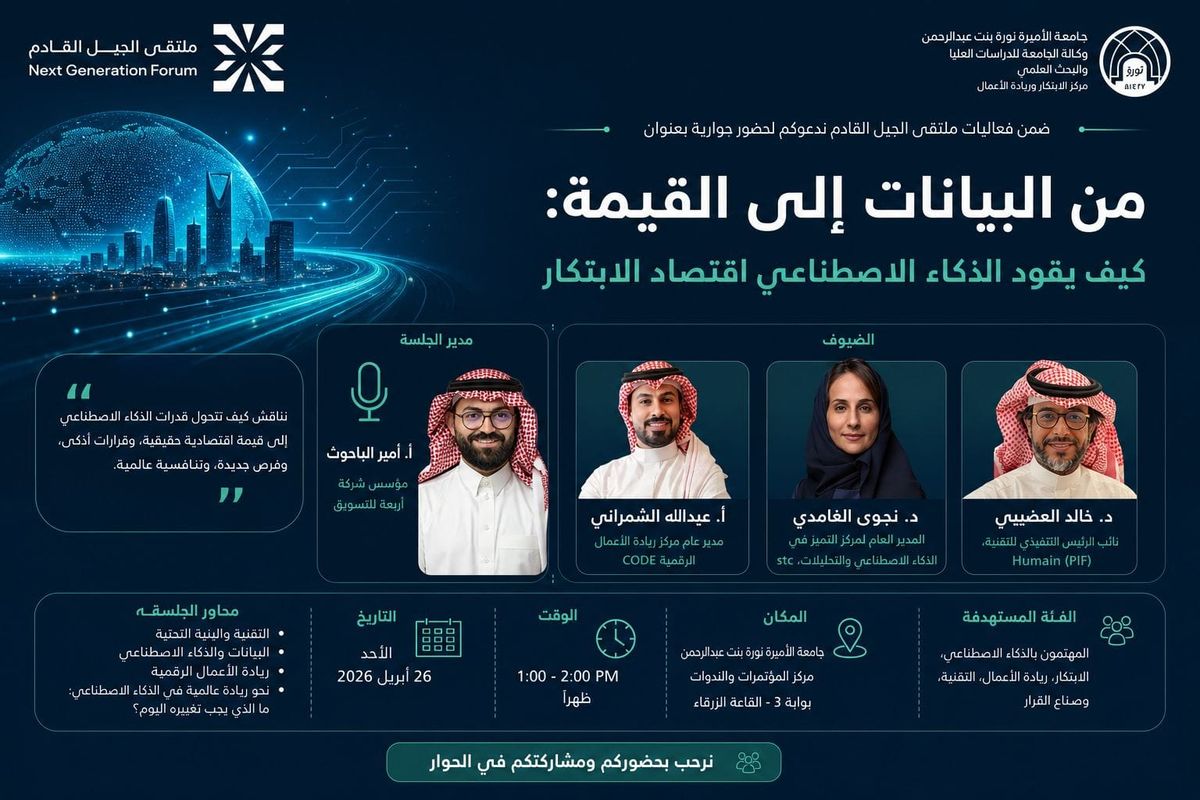
As discussed during a recent strategic dialogue at the Princes Noura University's Next Generation Forum with leaders from stc, CODE, and Humain (PIF), Saudi Arabia’s AI future will not be built by technology alone. It will be built by people prepared to lead it with judgment and skill.
The Strategic Need for Early Preparation
The AI economy will reward those who can do more than use tools. It will reward people who can connect ideas, question outputs, and build solutions that solve real problems. If young people are introduced to AI only as a shortcut, they may learn to depend on it without understanding it.
Early preparation creates a stronger foundation. It teaches students that AI is a system built on data, assumptions, and human choices. This matters for Saudi Arabia because national ambition needs national capability. Infrastructure and investment create opportunities, but people turn those opportunities into impact.
1. Cognitive Foundations: Teaching How to Think
The first skill the next generation needs is thinking. In the AI era, answers are easy to generate, but this creates a risk. If students only learn how to receive answers, they may stop learning how to question them. Young innovators must be trained to ask: Is this factually accurate? Is it biased? What is missing? Does it fit the real-world context? Critical thinking is essential because AI can sound confident even when it is wrong.
They also need Systems Thinking. Real problems are connected. A logistics solution affects delivery time, customer experience, and sustainability. Future innovators must learn to see these connections early. Innovation is not only about creating something new. It is about understanding what that new thing changes.
2. Data Fluency: The New Language of Value
AI runs on data, but data only becomes valuable when people know how to interpret it. The next generation does not all need to become data scientists, but they do need to become Data-Fluent. They should know how to move from “I think” to “the data suggests.”
Data fluency also includes responsibility. Data represents people: their behaviors, needs, and trust. If young innovators learn this early, they will be better prepared to build solutions that are not only smart but also ethical and sustainable. They must develop the intuition to know that while AI identifies patterns, humans must still provide the purpose.
3. Strategic Entrepreneurship: From Tool Users to Problem Solvers
One of the biggest risks in the AI era is confusing tool usage with innovation. A student may know how to create a presentation with AI, but that is not the same as solving a problem.
Young innovators must be trained to focus on problems before tools. AI platforms will change, but real challenges in education, healthcare, logistics, and energy will remain. This is where entrepreneurial thinking becomes vital. They should learn how to test ideas, listen to users, and improve based on feedback. The goal is to produce people who can turn a prototype into a working, market-ready solution.
The Human Element: Skills That Cannot Be Automated
As AI becomes more capable, human skills become more important. Technology must serve real people. A solution can be technically advanced but still fail if it does not understand language, culture, and trust. This is especially important in the GCC context, where solutions must be rooted in local realities.
Ethical Judgment and Adaptability are not soft skills. In the AI economy, they are leadership skills. AI can recommend and optimize, but it cannot carry responsibility. The real advantage is not memorizing one platform. It is learning how to learn, unlearn, and relearn as the world shifts.
A National Mission
Preparing the next generation cannot be the responsibility of schools alone. It requires collaboration between industry, government, and innovation ecosystems. National platforms like the Next Gen Forum are critical because they help students see the bigger picture: that AI is connected to national competitiveness and future jobs.
The real goal is to prepare our youth to create value with technology. That requires knowledge, but also judgment. It requires ambition, but also discipline. Saudi Arabia’s AI future will be shaped by the people who know how to use these tools to solve meaningful problems. When young people learn how to think, interpret data, and build solutions, they move from being users of innovation to becoming the architects of it.