
Soogk: The Smarter Way to Measure Local Competition Through Google Maps
Discover how Soogk turns Google Maps rankings, competitor activity, branch performance, and customer sentiment into measurable market intelligence.
A 4.5-star rating may look strong, but a rating alone does not show the full competitive picture. Your business might have positive reviews while still ranking below nearby competitors. One branch may be gaining visibility while another is falling behind. Customers may consistently praise one part of the experience while repeatedly criticising another.
"You can't improve what you can't measure. In local search, most businesses are flying blind."
You can uncover these insights manually through Google Maps, but comparing multiple branches, competitors, locations, and reviews takes time. Soogk turns that scattered information into a measurable competitive view, helping users see where they stand, what is changing, and where action may be needed.
Google Maps Is a Competitive Environment
Customers rarely study every business in an area before making a decision. They search for a café, restaurant, store, or service nearby and begin with the options Google Maps places in front of them. This means a business is not only competing through its products, prices, and physical experience. It is also competing for visibility at the exact moment a customer is deciding where to go.
Yet many owners still evaluate their Google Maps presence by looking at two numbers:
- Their average rating
- Their total number of reviews
These numbers are useful, but without context, they can be misleading. A branch may have a strong rating but appear below several competitors. Another may have thousands of reviews but be receiving increasingly negative comments. A newer competitor may be climbing quickly even though it still has fewer reviews. Knowing your numbers is different from knowing your position.
What Soogk Helps Businesses See
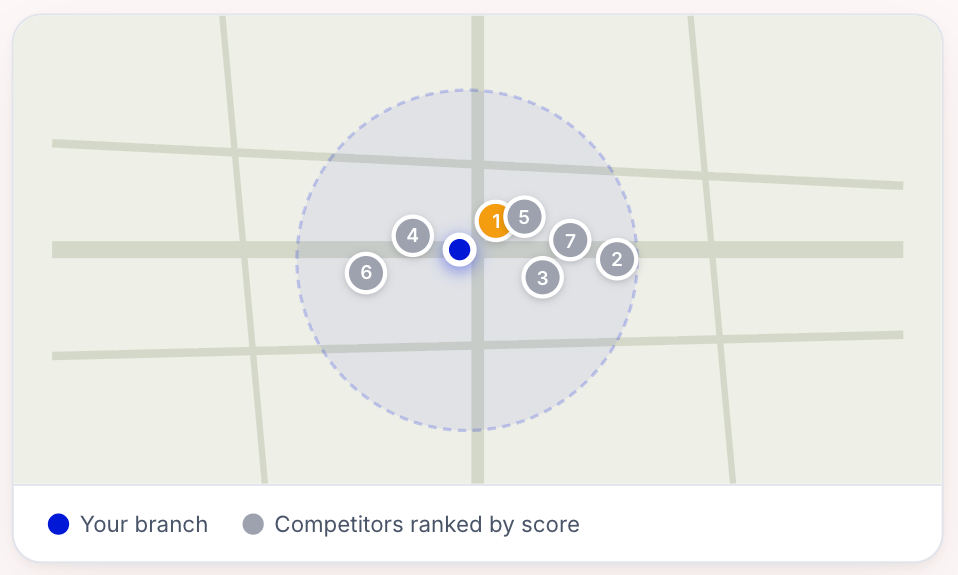
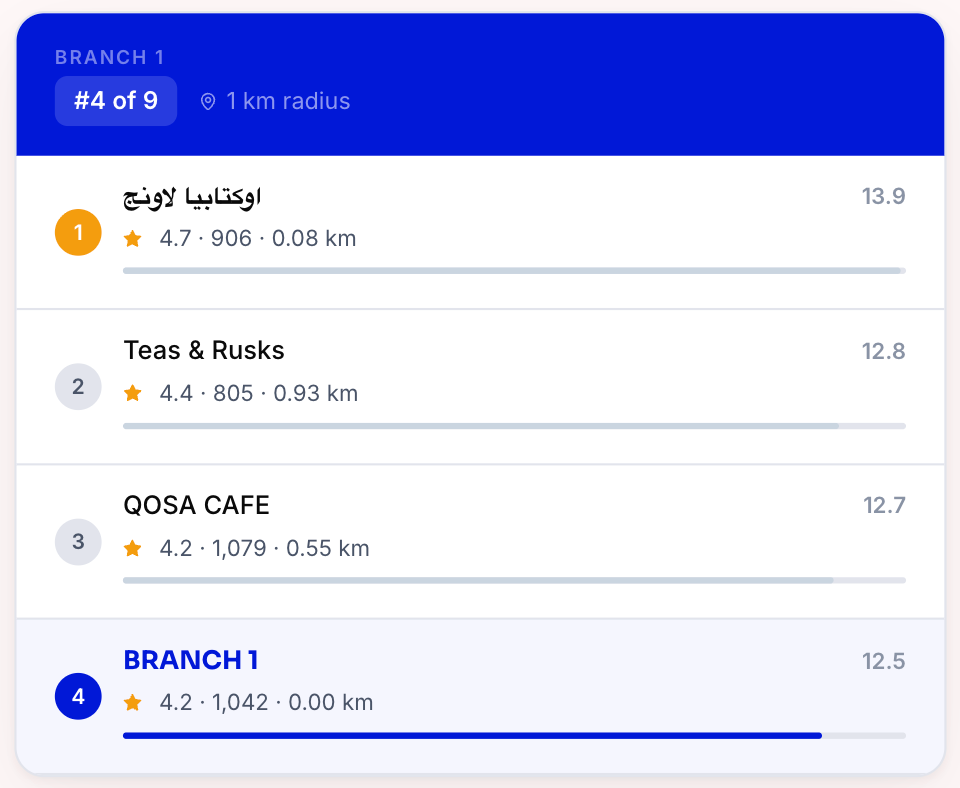
Soogk transforms Google Maps activity into a measurable competitive view. Businesses can examine how their locations rank within a selected geographical radius and compare that performance with nearby competitors. Instead of relying on one broad city-level result, they can understand what customers are likely to see within the areas that matter to each branch.
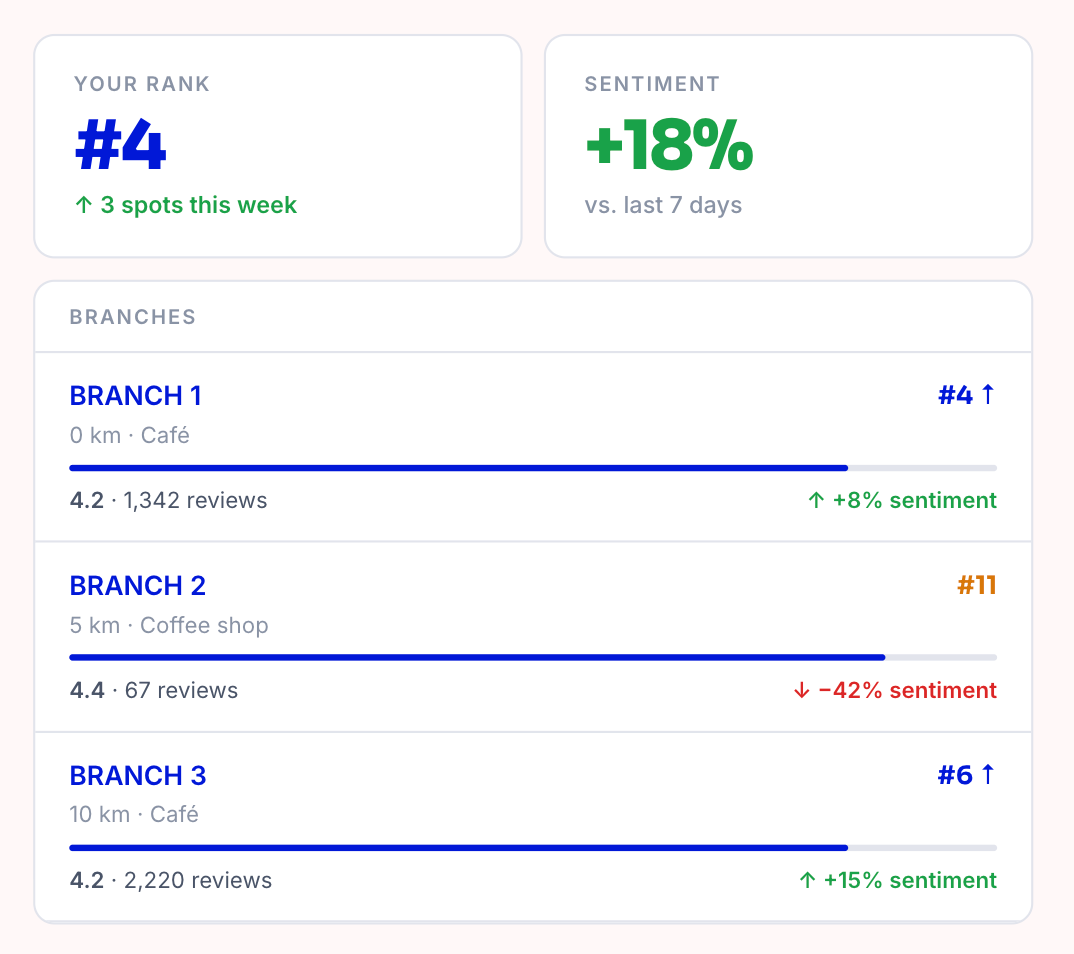
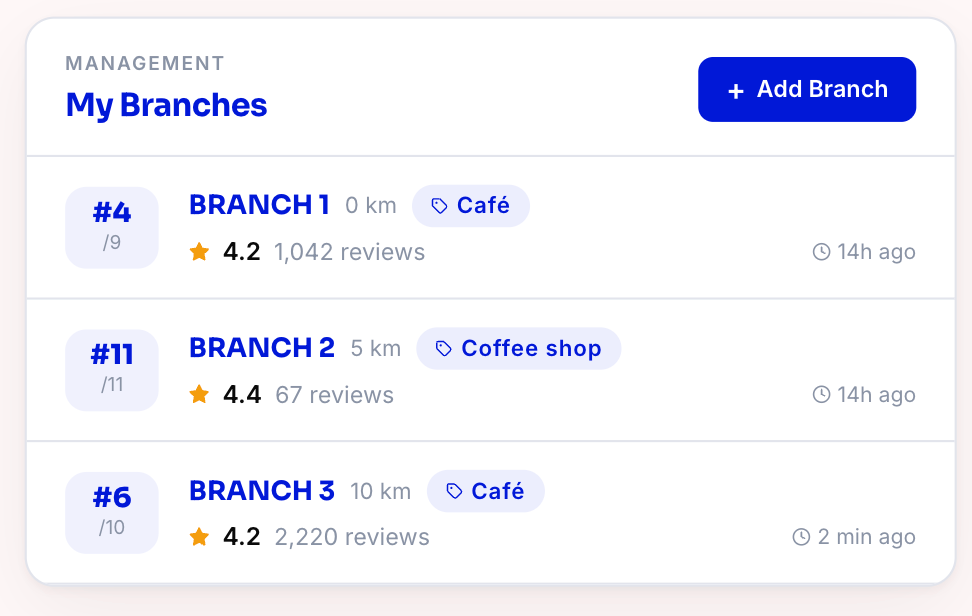
For multi-branch businesses, Soogk also creates a portfolio view. An owner or manager can compare locations without opening and reviewing every Google Business Profile separately. This helps answer practical questions such as:
- Which branch has the strongest local position?
- Which location is losing visibility?
- Is a competitor moving ahead in a particular area?
- Which branch is receiving more negative customer feedback?
- Are customers reacting differently to the same brand across locations?
The result is not another collection of charts. It is a faster way to identify where attention is needed.
Reviews Tell You More Than a Star Rating
Two businesses can both have a rating of 4.3 and still deliver very different customer experiences. One may be praised for its service and atmosphere but criticised for waiting times. The other may receive positive comments about its prices while customers repeatedly mention inconsistent quality. The rating alone hides this difference.
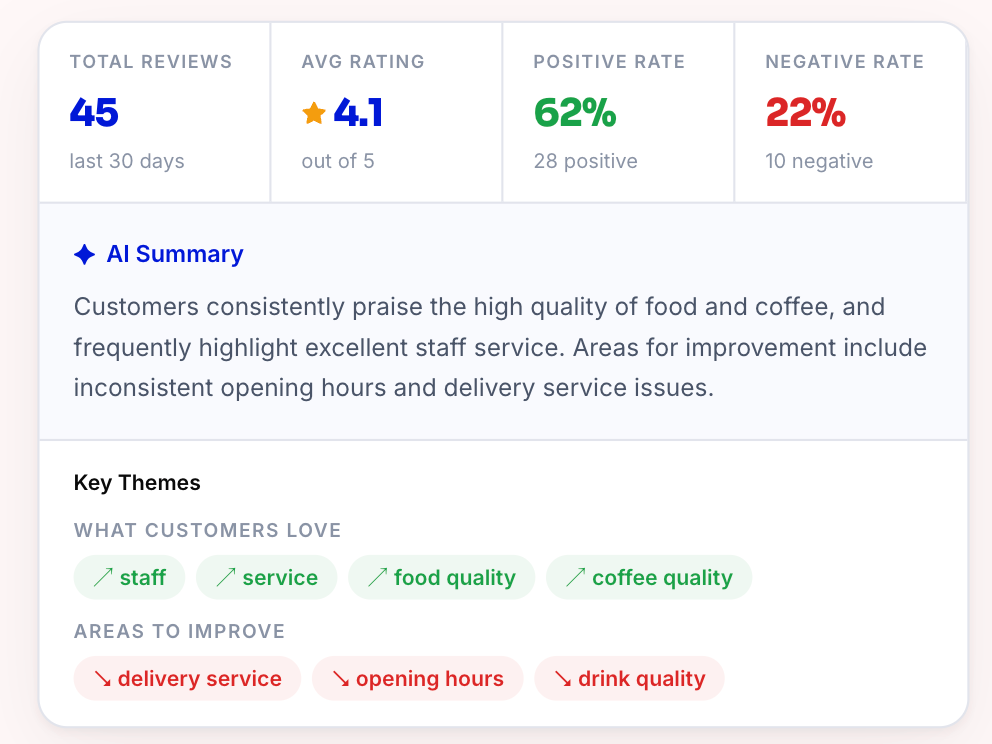
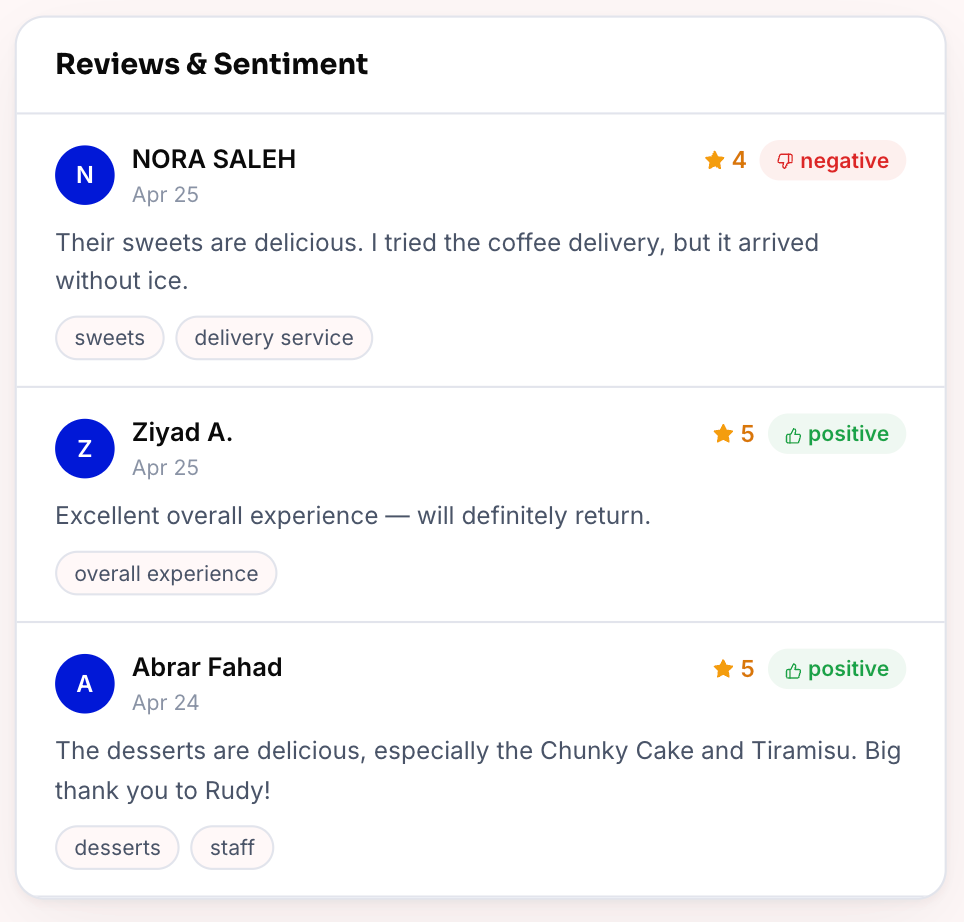
Soogk uses AI-powered sentiment analysis to help businesses understand the meaning behind customer reviews. This makes it easier to identify recurring positive and negative themes without manually reading hundreds or thousands of comments. For an individual branch, this can reveal operational problems. Across several branches, it can expose wider patterns.
A restaurant group, for example, may discover that customers consistently praise the food across all locations but complain about service at one branch. That is a more useful insight than simply knowing that the branch has a slightly lower rating. It turns customer feedback into a signal for action.
Built for Businesses With More Than One Location
The value of Soogk becomes especially clear when a business operates several branches. As the number of locations increases, maintaining a clear view of performance becomes more difficult. One branch may be highly visible while another barely appears in relevant searches. Customer sentiment can also vary significantly based on staff, neighbourhood, management, accessibility, or the local competitive landscape. Looking only at the brand’s overall reputation can hide these differences.
Soogk allows decision-makers to evaluate each branch individually while still seeing the wider portfolio. This gives owners, operations teams, and marketing departments a shared view of where the business is performing well and where intervention may be required. It can help teams decide whether a branch needs:
- Better review management
- Operational improvements
- More local marketing support
- A stronger Google Business Profile
- Closer observation of nearby competitors
This is particularly relevant for restaurant groups, café chains, franchises, clinics, salons, gyms, retailers, hospitality concepts, and other location-based businesses.
Competitor Analysis Without the Guesswork
Competitor analysis is often based on assumptions. A business may see a busy competitor and assume it is performing well. It may notice a new branch opening nearby and treat it as an immediate threat. It may copy another brand’s promotion without knowing whether that brand is actually gaining local visibility or customer approval. Soogk brings measurable information into that process.
By examining nearby businesses, rankings, reviews, categories, and customer sentiment, teams can compare themselves with the competitors that appear in the same local searches. This is more relevant than comparing a small neighbourhood branch with the biggest brand in the country. Local businesses compete market by market, neighbourhood by neighbourhood, and sometimes street by street. Soogk keeps the analysis connected to that reality.
Who Is Soogk For?
Soogk is particularly useful for:
- Multi-Branch Business Owners
Owners can see which locations are leading, which are falling behind, and where competitor pressure is increasing.
- Operations Teams
Customer sentiment can help teams uncover recurring service, quality, waiting-time, cleanliness, or experience issues at specific branches.
- Marketing Teams
Marketers can identify locations that need greater visibility, local campaigns, reputation support, or more focused content.
- Franchise Operators
Franchisors and franchisees can compare branch performance and identify inconsistencies across the network.
- Agencies and Consultants
Marketing agencies, local SEO specialists, and business consultants can use clearer competitor and branch-level insights when advising clients.
- Businesses Considering New Locations
Competitive activity within an area can provide useful context when evaluating potential neighbourhoods or markets.
The Edge: From Monitoring to Decision-Making
Many platforms help businesses monitor reviews. Others provide general SEO information or individual Google Business Profile metrics. Soogk’s edge is the way it connects three areas that businesses often examine separately:
- Local Google Maps ranking
- Competitor performance
- Customer sentiment across branches
This creates a more complete picture. A decline in ranking means more when it can be viewed alongside competitor movement. A drop in customer sentiment becomes more useful when it can be traced to one branch. A strong rating becomes more meaningful when the business knows how it compares within the surrounding market. Soogk is therefore not only about collecting data. It is about helping businesses interpret their position and decide where to act.
You Cannot Improve What You Cannot See
Businesses spend heavily on branding, advertising, interiors, service, and expansion. But when a customer searches nearby, their decision may still begin with a small group of results on Google Maps. That makes local visibility and customer perception too important to leave to assumptions.
Soogk gives business owners a clearer view of how their branches are performing, what customers are saying, and where competitors are gaining ground. Because the map does not only show where a business is located. It shows where it stands.
Also Read: 8 Saudi Digital Tools Changing How We Create, Market, & Connect